The Technoblade Larping Situation Is Sad...
Is This Ethical?
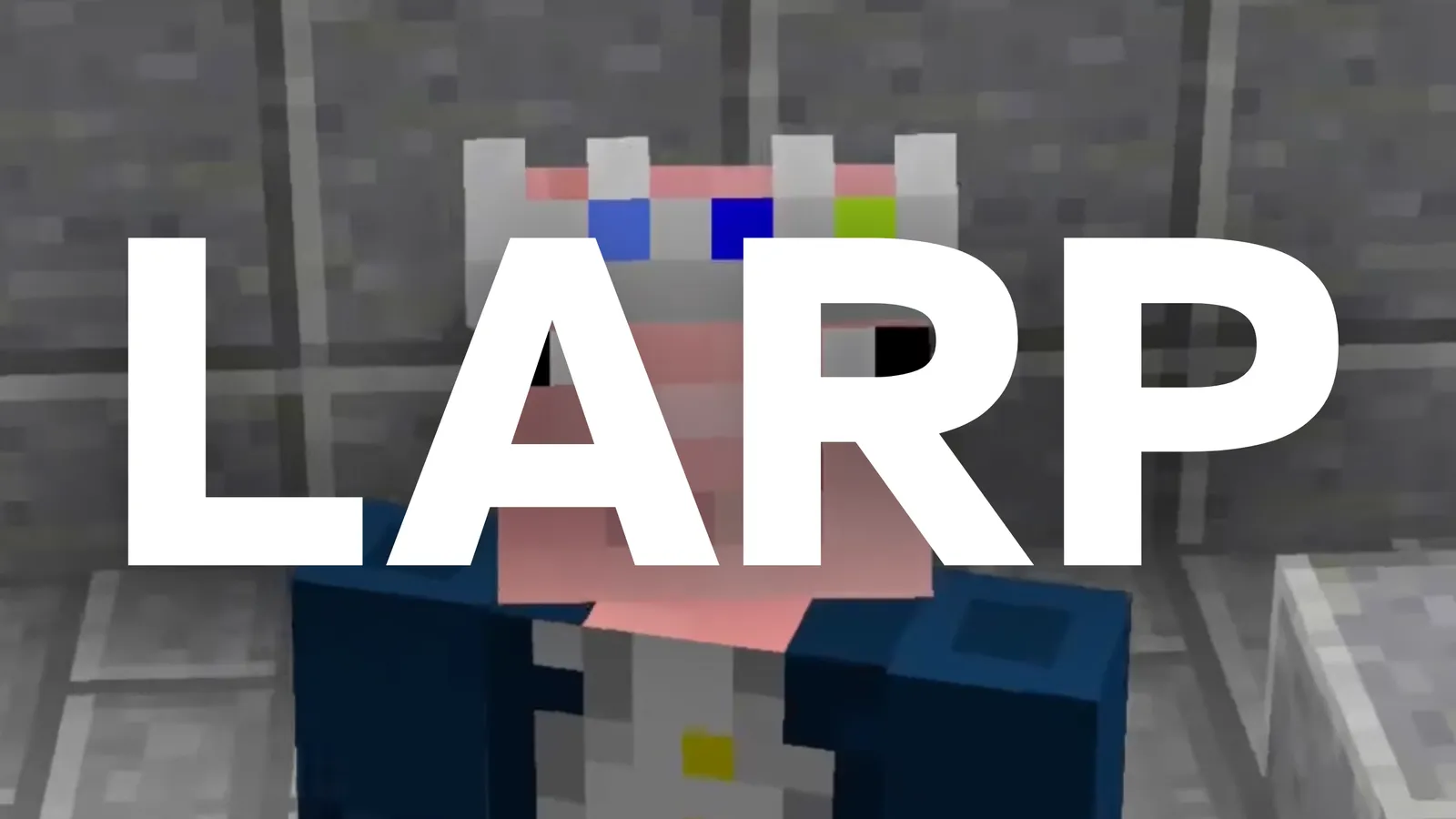
Watch the full video on YouTube.
Background
Over the past few months, creators LARPing as other YouTubers have begun gaining traction online. Rather than traditional role-playing, these creators recreate another YouTuber’s mannerisms, humour, editing style and content.
For the most part, this trend has been relatively harmless. However, one creator has sparked far more controversy than the rest.
On 2 June 2026, StrikerLPB began role-playing as Technoblade, the beloved Minecraft YouTuber who passed away from sarcoma four years earlier.
The initial response was overwhelmingly positive. Viewers praised how closely Striker recreated Technoblade’s humour and editing style, with some claiming that “Techno would have loved this.” As the channel grew, Striker even collaborated with Skeppy, one of Technoblade’s closest friends.
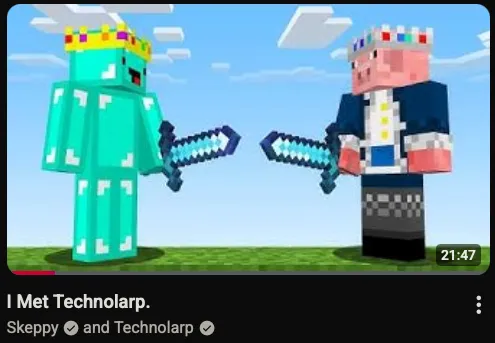
However, once the videos reached audiences beyond the LARP community, reactions became far more divided.
Some viewers saw the channel as a heartfelt tribute that allowed fans to revisit the style of Technoblade’s content. Others felt uncomfortable with someone building an entire online identity around a person who had passed away.
The controversy soon drew attention from larger creators and members of Technoblade’s community, raising a difficult question: where should the line be drawn?
Is recreating a deceased creator’s persona simply another way of celebrating their legacy, or does continuing that identity through a new channel cross an ethical boundary?
To understand why the situation became so divisive, we need to examine the questions surrounding identity, profit, consent and the responsibility placed on Technoblade’s family.
Identity: Tribute or Imitation?
To begin, it is important to acknowledge that Striker makes it clear he is not actually Technoblade.
He wears a silver crown instead of Technoblade’s iconic gold one, signalling that the character is inspired by Technoblade rather than intended to replace him. His video descriptions also include the disclaimer:
“I am not Technoblade. This is all for the love of the game.”
Having watched several of his videos, I have to admit that the imitation is surprisingly convincing. The humour, pacing and editing style feel remarkably similar to Technoblade’s original content.
As someone who grew up watching Technoblade, I found the videos genuinely nostalgic. At the same time, they also felt slightly eerie because I knew I was watching an imitation rather than the real person.
This is where some people compare Striker to tribute performers.
For decades, impersonators have paid tribute to celebrities such as Michael Jackson, Elvis Presley and Freddie Mercury. Audiences know they are not watching the original person, and these performances are usually seen as celebrations of their legacy rather than exploitation.
So why does this situation feel different to so many people?
One possible reason is that Striker is not simply recreating a larger-than-life stage persona. He is recreating the identity of a YouTuber whose appeal came from feeling like a real and relatable person.
He is copying more than Technoblade’s appearance. He is also recreating his humour, personality, editing style and the way he interacted with his audience.
That feeling became even stronger when Striker collaborated with Skeppy. Watching someone role-playing as Technoblade interact with a person who had genuinely known him blurred the line between paying tribute and stepping into someone else’s place.
Had this been a single tribute video, many viewers may not have thought twice about it. However, Striker had built an entire channel around continuing the persona. For some viewers, that made the project feel less like a tribute and more like assuming another person’s identity.
Whether that distinction feels meaningful ultimately depends on the viewer, but it is one of the main reasons the situation became so divisive.
Money: Can a Tribute Be Profitable?
Intent is only one part of the discussion. Once money enters the picture, the ethical questions become far more complicated.
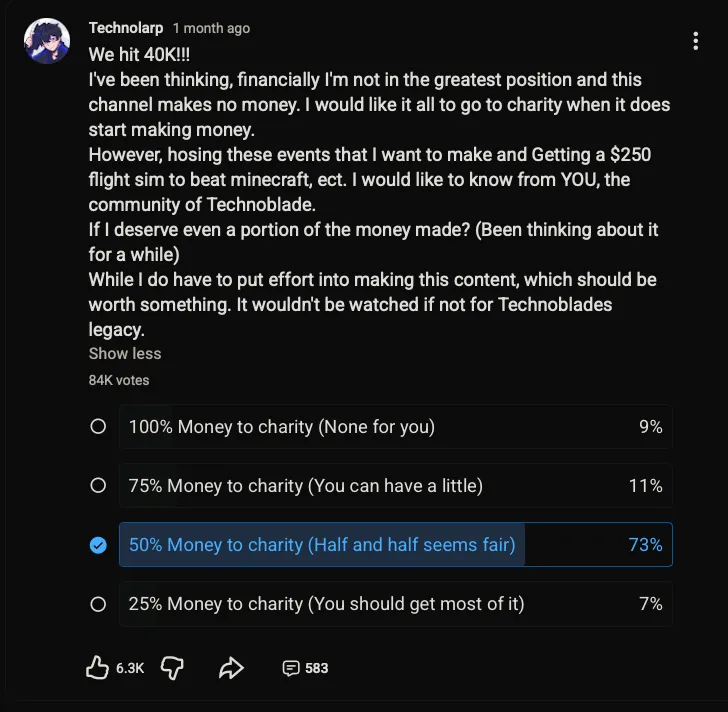
Striker initially claimed that he would not make money from the project. However, during one of his streams, he included both a charity donation link and a personal donation link. He later asked his community through a YouTube post how future donations should be handled, explaining:
“Financially I’m not in the greatest position and this channel makes no money.”
Striker proposed splitting the proceeds between himself and charity. After asking viewers to vote, the majority supported a 50–50 split.
This raised another difficult question: is it appropriate to profit from portraying someone who has passed away?
On one hand, creating YouTube videos takes time and effort. Striker was also open about his financial situation, asked his community for input and planned to donate half of the proceeds to charity.
From this perspective, viewers were simply choosing to support a creator whose content they enjoyed.
However, the concern was not necessarily the existence of the donations, but what made those donations possible.
The channel attracted attention because it was built around Technoblade’s identity. Since Technoblade could no longer consent to his persona being used in this way, some viewers felt uncomfortable with Striker personally benefiting from it.
Even if half of the money went to charity, Striker would still be earning money from portraying someone who had passed away. That is where the dilemma lies.
If a tribute brings joy to thousands of fans, is it wrong for its creator to be compensated for the work involved? Or does relying on the identity of someone who can no longer give permission fundamentally change the situation?
Pressure on Technodad
One of the biggest criticisms concerned the responsibility Striker placed on Technodad.
From the beginning, Striker maintained that he would only stop role-playing as Technoblade if Technodad personally asked him to. However, he had never claimed to have received permission from Technoblade’s family, while several of Technoblade’s close friends had already voiced their opposition.
Technodad himself admitted that he did not know how to respond. In a Reddit thread, he wrote:
“I just don’t know how to react to this. I mean, certainly it’s flattering to Techno. But, like, what am I supposed to do?”
He also revealed that Striker had contacted him several times for his opinion, but that he had delayed responding because he did not know what to say. Technodad ultimately described his position as “inconclusive,” adding that he was still thinking about the situation.
His uncertainty highlighted the difficult position he had been placed in. Rather than deciding for himself whether the role-play was appropriate, Striker’s stance effectively left the final decision to Technodad.
Despite this, Striker continued to present Technodad’s opinion as the deciding factor. Responding to criticism, he said:
“I only answer to him.”
When asked whether he would rebrand the channel, he replied:
“Do I HAVE to? No, Technodad has not told me I can’t do content.”
On the surface, this could be interpreted as respectful. After all, Technodad arguably had more reason than anyone else to have a say.
However, critics argued that it placed an unfair burden on him.
As YouTuber Simon explained in an X post:
“It forces a bereaved father to either bless an ongoing imitation of his son or become the person who shuts down a channel after roughly 190,000 fans have attached themselves to it.”
If Technodad remained silent, that silence could be interpreted as approval. It could also encourage other creators to build similar channels around Technoblade’s identity.
However, if he publicly objected, he risked being blamed for ending a channel that hundreds of thousands of viewers had become invested in.
This was not simply asking another creator to settle an online disagreement. It was asking a grieving father to decide whether someone else should continue portraying his late son.
To millions of viewers, Technoblade’s channel is a piece of internet history. To his family, however, it represents his work, his legacy and a deeply personal part of their lives.
Placing the responsibility on Technodad to decide whether another creator could continue building an audience around that identity therefore created an emotional burden that many believed he should never have had to carry.
The End of the LARP
After Striker was doxed and received death threats, Technodad released a statement asking for the role-play to end.
He wrote that he was:
“Asking for this to please stop, and for the persona in question to cease.”
Shortly afterwards, Striker announced that he would no longer role-play as Technoblade.
He later unlisted the existing videos and placed them in a playlist, meaning they would no longer appear publicly on his channel but could still be watched through the playlist.
Striker also stated that he planned to rename the channel to StrikerMC, although, at the time of writing, the name had not yet been changed.
This partly addressed the criticism surrounding the channel. The videos were no longer being actively promoted, and Striker had taken steps to separate his future content from the Technoblade persona.
However, by keeping the same channel, Striker also retained the subscribers, attention and support he had already gained while role-playing as Technoblade. Even if the original videos remained unmonetised, his future content could still benefit from an audience built around the identity of someone who had passed away.
Whether these steps are enough ultimately depends on whether viewers believe Striker should be able to retain the audience and support he gained while role-playing as Technoblade.
Conclusion
Throughout this controversy, one phrase appeared repeatedly:
“Techno would have loved this.”
Maybe he would have. Maybe he would not have.
The reality is that none of us can know. Technoblade is no longer here to explain how he would feel about someone building an audience by portraying him. While it is natural for fans to speculate, neither side can fairly claim to speak on his behalf.
That uncertainty is what makes this situation so difficult.
Striker did not pretend to literally be Technoblade. He included disclaimers, made visible changes to the persona and ultimately respected Technodad’s request to stop.
At the same time, the channel raised difficult questions about whether anyone should build an audience around the identity of someone who can no longer give consent.
Perhaps there is no single correct answer. The ethics of the situation depend not only on Striker’s intentions, but also on the effect his actions had on Technoblade’s family, the role of money and the precedent the channel could set.
If one creator can successfully build a channel around the identity of someone who has passed away, where should the line be drawn? What would stop others from doing the same?
However, this discussion also highlights something more meaningful.
Four years after his passing, Technoblade’s legacy remains alive. His videos continue to make people laugh, his community remains active and fans still celebrate the impact he had on millions of viewers.
There was a time when I would play his videos while studying. In a way, he was my version of the “lofi girl,” and I know I am far from the only person who still returns to his content.
Perhaps that is what should remain after the controversy fades: the fact that, even years later, one creator can still bring people together, inspire conversations and leave behind a legacy that continues to matter.
Technoblade never dies.